
Q4 2025 (October - December 2025)
The Unity Project shares analysis of the data on Change of Conditions (CoC) applications included in the UK Visa & Immigration Transparency Data, which is published quarterly. This briefing as usual covers application numbers, decision times and backlogs, and includes updates on recent changes to the CoC guidance.
Applications remain low
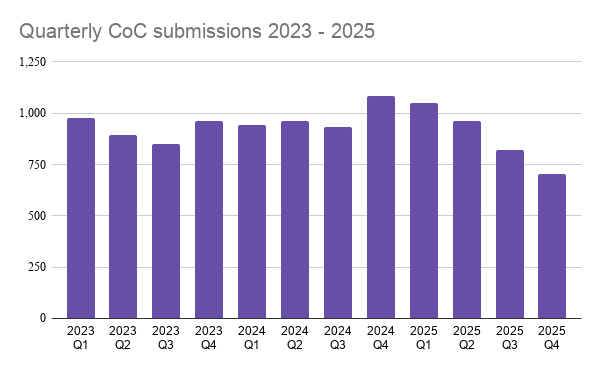
- In Q4 2025, 706 applications were submitted - the second lowest number recorded since the government began releasing statistics.
- In line with previous data releases, the Home Office continues to update and revise earlier figures of applications submitted.
The number of applications submitted in the last quarter of 2025 was 706, marking the second-lowest submission figure since publication of statistics began. The lowest number of applications submitted on record was in Q3 2017 when 363 applications were submitted. This quarter, Q4 2025, is marginally lower than Q1 2018 when 708 applications were submitted. However, when viewed across the full year, 2025 totals are broadly in line with those seen in 2022 and 2023, following a slight decline in 2024.
Although we cannot ascertain the reasons behind the steady continual decline from the data alone, we highlighted the downward trend in our previous analysis of Q3 2025. One possible reason influencing applicants’ decision to apply could be the government’s Earned Settlement proposals announced in November 2025, which seek to extend the pathway to settlement. This is something we’ll be monitoring going forward.
Last quarter, we reported 760 applications submitted. The latest data release amends this figure to 821, an increase of 61 applications.
Previous quarterly figures have been revised. The most recent quarters are as follows:
- Q4 2024 – 1,082 (previously reported as 1,030)
- Q1 2025 – 1,052 (previously reported as 1,037)
- Q2 2025 – 964 (previously reported as 928)
- Q3 2025 – 821 (previously reported as 760)
The frequent revisions make it difficult to track trends.
Decision-making times and backlog
- Of the 706 applications submitted in Q4 2025, 598 are still pending.
- 1020 decisions in total were made in Q4 2025, up from 793 in the previous quarter.
706 applications were submitted in Q4 2025 with 598 awaiting a decision. Although the Home Office reports making 1020 decisions in total in Q4 2025, which is an increase from 793 in the previous quarter, only 108 of these relate to applications submitted in Q4 2025. This means around 85% of applications submitted in that quarter are awaiting a decision.
The total number of pending applications now stands at 868. This represents 123% of the number of applications submitted in Q4 2025, meaning the backlog remains larger than the number of new applications received. Although this is slightly lower than in Q3 2025 (127%), the backlog remains high.
In this latest data release, there now appear to be applications dating back to Q3 2021 that are still pending. These historic pending applications did not appear in the last quarterly data release, which stated that there were no pending applications before Q2 2024. Now there are 65. This means that individuals who submitted applications over four years ago are still awaiting a decision, highlighting the extent of delays and the prolonged uncertainty faced by applicants, who are unable to access public funds while awaiting a decision. We are concerned by the appearance of these historic pending applications and have contacted the Home Office directly to clarify the situation.
In our analysis of Q2 2025, we highlighted decision times doubling from two months to four months and that delays of over two months may be unlawful and could potentially be challenged. This follows from a judgement where the Home Office was found to have caused prolonged delays in accepting claimants were destitute. These delays resulted in applicants enduring several weeks and in some instances months of destitution before a decision was reached. The current data suggests that these delays remain a persistent issue and highlights ongoing concerns about the risk of applicants experiencing prolonged periods without essential support while awaiting a decision.
CoC guidance update
In February 2026, the Home Office updated its guidance on CoC, introducing a triage system that prioritises CoC applications based on vulnerability. The guidance states that there is no “no specific service standard” for deciding applications but that decision makers should make all “reasonable efforts to decide such requests promptly”. However, we know from our reporting that delays in CoC decisions are a recurring issue. Under the new system, applicants are now divided into three tiers:
- Tier 1 is for the most urgent cases, such as street homeless or serious vulnerability, which should be “considered” within 72 hours.
- Tier 2 is for serious but less urgent vulnerabilities, to be considered within 14 days.
- Tier 3 is for all other cases, which are considered as usual without a fixed timeframe.
While the system aims to prioritise the most vulnerable applicants, there is still an absence of a decision deadline and lack of a timeframe for Tier 3, which limits the ability to address delays. Addressing the backlog will require an increase in Home Office decision-making capacity.
We are concerned that this prioritisation process risks increasing the evidential burden on applicants, who need to provide evidence to be considered for Tier 1 or Tier 2. There is also the risk that Tier 3 applicants will be deprioritised, even as they face destitution. We will be monitoring this new system closely over the coming months.