
Q2 2026 (April - June 2026)
The Unity Project shares analysis of the data on Change of Conditions (CoC) applications included in the UK Visa & Immigration Transparency Data, which is published quarterly. This briefing as usual covers application numbers, decision-making and processing times.
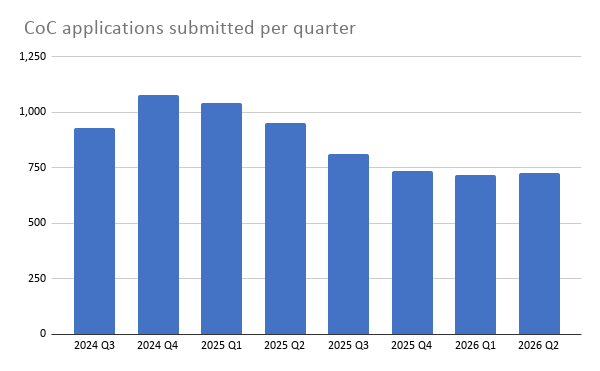
The most significant story from the recent data release is the continued historically low number of CoC applications submitted.
Decline in applications
- In Q2 2026, 727 CoC applications were submitted, around a 25% decline from this time last year.
The number of applications submitted this quarter is very slightly up on Q1 of 2026 (which was originally reported as 702, and has been revised up in this release to 720). As we've highlighted in previous analyses, this is a significant decline since Q1 2025 (when 1,044 applications were submitted).
It is possible that the government's so-called 'Earned Settlement' proposals, which were first trailed in the Immigration White Paper in May 2025, may have contributed to this decline in applications. The proposals seek to increase the standard qualifying period for permanent residence from five to ten years and penalise people for accessing welfare benefits, further prolonging their path to settlement. Millions of people have now been living with uncertainty about their pathway to settlement for well over a year, and the data suggests that hundreds if not thousands of people have chosen to remain in destitution and vulnerability rather than making a Change of Conditions application because they are worried about the risks of doing so. This hypothesis is supported by anecdotal evidence from people we have spoken to and other organisations working on Change of Conditions applications.
Revision of figures
- In line with previous data releases, the Home Office continues to update and revise earlier figures of applications submitted.
A further issue we have been monitoring is the ongoing revision of historic application numbers. With each data release, previous quarterly figures change, making it difficult to track trends accurately. The Q2 2026 data release includes revisions dating back over two years.
We raised this issue with the NRPF Forum in March and July 2026. We were advised that the inaccuracies were due to the transition to the ATLAS caseworking system and work remains ongoing to resolve those issues. The Home Office has given us no timetable for completing this work.
CoC backlog
- There are currently a total of 338 pending applications.
- 34% applications submitted in Q2 of 2026 are pending.
- 1 application from Q4 of 2024 is still pending.
The Home Office has made substantial progress in recent quarters to reduce the CoC backlog. Nearly 1000 applications per quarter were processed for the last three quarters (up from an average of less than 700 applications per quarter in 2024). The percentage of applications processed in the same quarter that they were submitted has increased from 16% to 66% in the last two quarters. Since the last data release, the total number of pending applications has reduced from 532 to 338. The backlog is now in line with the pre-2023 average.
It is clearly a good thing that the backlog is reduced, however the decline in applications is just as significant as the increase in Home Office casework output. Similar to other immigration and asylum data released this quarter (as reported by Free Movement), a positive story for the Home Office indicates greater human suffering and potential longer term social and economic damage.
Decision-making times and acceptance rate
- The most recent reliable average decision time is 87 days (Q4 2025).
- The most recent reliable acceptance rate is 58% (Q4 2025).
The Home Office reports a processing time of 25 days for Q2 2026. As we have noted in previous analyses, this figure is misleading and is likely to underestimate the actual waiting time experienced by applicants. Decision timeframes increase once pending applications are eventually processed. The most recent quarter with reliable data on the decision timeframe is Q4 2025. Over 98% of applications from this quarter have now been processed, with an average decision time of 87 days. This is far too long, however it shows continued improvement from the extremely slow decision times recorded in 2024, which peaked at 151 days in Q3 - 5 months.
The Home Office introduced a new prioritisation process in February 2026, following a 2024 High Court judgement, which found that processing times of two to four months were unacceptable for people facing destitution and called for a practical and effective prioritisation process. We welcome the Home Office’s attempts to address issues with decision times. If the new system is effective in addressing that we would expect to see a continued reduction in decision times over the coming quarters.
The acceptance rate for Q2 2026 is reported as 70%. However, similar to the processing time, this figure is misleading and typically falls once more applications are processed. The acceptance rate for Q4 of 2025 is 58%, which is the most recent reliable data point available.