
Q3 2026 (July - September 2026)
The Unity Project shares analysis of the data on Change of Conditions (CoC) applications included in the UK Visa & Immigration Transparency Data, which is published quarterly. This briefing as usual covers application numbers, decision-making and processing times.
While decision times have improved, applications remain historically low with some applicants still facing significant delays.
Continued decline in applications
-
- In Q3 2026, 766 CoC applications were submitted.
Although there has been a slight increase in applications this quarter compared to last quarter, the number has been roughly stable for the last four quarters. The one-year rolling average is now 743 applications per quarter, a decline of around 25% from the previous year. The continued fall in applications should not be read as a sign that fewer people need access to public funds. Rather, it may reflect the impact of the announcement of the ‘Earned Settlement’ changes, which propose penalising people by extending their path to settlement if they have claimed public funds. Even before the proposed changes take effect, the prospect of a longer route to settlement may be deterring people from applying. We’ll continue to monitor this to see whether future data releases show another steep decline in applications.
Decision times and backlog
-
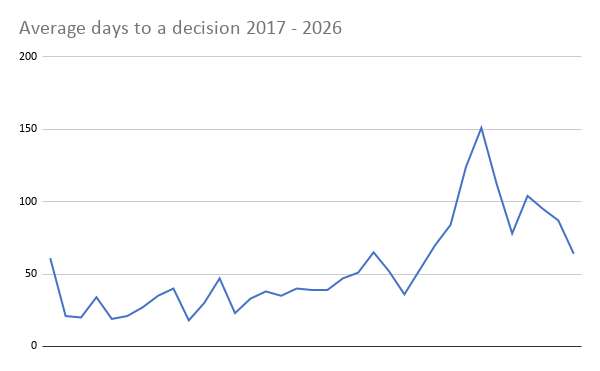
- The most recent reliable average decision time is 62 days (Q1 2026), an improvement from 91 days in 2025.
- The oldest outstanding application has been awaiting a decision for nearly two years.
The number of decisions made fell by 20% from the previous quarter (943 to 764) which means that progress on reducing the backlog has stalled. The Home Office made almost exactly the same number of decisions (764) as applications received (766), so the backlog showed little to no change from the previous quarter.
Last quarter, there were 29 applications that had been awaiting decisions from 2024 and 2025, and the Home Office has only dealt with 4 of these long-standing cases. The oldest outstanding case has been waiting for a decision for nearly two years. It is unclear why these cases have remained unresolved for so long and the Home Office has offered no explanation, despite our requests. This is gravely concerning, particularly as the High Court ruled in 2024 that processing times of two to four months were unacceptable for people facing destitution (read more about the ruling here). A wait of nearly two years is difficult to reconcile with that judgment. The Home Office should review these cases urgently.
There is increasing evidence that decision times have reduced significantly since introduction of the three-tier prioritisation system midway through Q1 of 2026. We now have reliable data on decision times from Q1 2026 - 62 days. This represents a substantial improvement (50%) from 2025, when the average days to decision was 91 days.
Under the prioritisation system, the Home Office sorts CoC applications into three tiers based on urgency and vulnerability. Tier 1 covers street homeless applicants or those with the most serious vulnerabilities (decisions within 72 working hours), Tier 2 covers applicants or dependents with other serious vulnerabilities (within 14 working days) and Tier 3 covers all other applications, which should be considered as soon as possible, with no set timeframe.
For Q2 2026, the average time to decide, with 95% cases addressed, is 32 days. We expect this to rise between 5 and 10 days once the remaining cases have been processed, settling at around 40 days. This would be a significant improvement and would mean fewer people being trapped in situations of destitution and danger for months on end due to bureaucratic delays. Decision times of this length were the norm until 2022, when they started to rise steadily. Average time to decision peaked at a truly appalling 151 days in Q3 2024. In that quarter, over 900 people were left waiting an average of five months for a decision on their application.
We commend the Home Office for this improvement and hope to see decision times reduce further to pre-pandemic levels of 30 days or fewer. We also call on the Home Office to publish data on decision times for each tier under the new prioritisation process to demonstrate that it is meeting the standards it has set itself for those in particular need.
Acceptance rate
-
-
- The most recent reliable acceptance rate is 58% (Q2 2026).
- The most recent reliable acceptance rate is 58% (Q2 2026).
-
The published acceptance rate for Q3 2026 is 69%. However, as we have mentioned before, this figure is misleading because many applications from Q3 have not yet been processed. The most recent reliable acceptance rate is 58%, which comes from Q2 2026. This figure is unchanged from the previous quarter. The majority of people who apply for a CoC are found to be in positions of destitution. It is therefore very concerning to see a 25% decline in the number of people making applications and it would be reasonable to assume that this means more individuals and families remaining in destitution when they previously would have felt confident to apply for access to public funds.
Demographics
Demographic data remains in line with previous quarters. We will do a deeper dive into this in our end of 2026 data analysis, following publication of the next quarter’s data.